Buffalo News Refresh Blog – September 2016


Try Healthier Carb Substitutes

by: Holly R. Layer

I recently received a question about ‘carb substitutes.’ As I couldn’t engage the person directly, I didn’t know if they simply wanted GRAIN substitutes, or better sources of carbohydrates. So, I’ll start from the beginning and address both topics.

I like to tell my patients and clients that the term ‘carbohydrates’ can be equated to sugar, because that’s what they break down into in the body in the form of glucose. This glucose gets turned into energy (to use immediately) or to be stored in the muscles (to use later), and any additional goes to the liver to be stored as fat.

According to the 2010 Dietary Guidelines for Americans, our diets should be approximately 45-60% carbs, 20-35% fat and 10-35% protein. As you can see, carbs make up at least half of our energy intake. I realize that number may seem high, taking into account the recent low-carb craze, but stay with me–carbs are more than just bread and pasta, and we really do need that much for our bodies to function well. (There’s a lot more I can talk about in terms of refined vs. unrefined grains, fiber and starch, simple and complex carbs, but we only have so much room. Keep writing in questions!) For now, I’ll simply discuss food groups and carbohydrates.

Which brings me to our reader’s question about carb ‘substitutes.’ First of all, you cannot substitute protein and fat for carbs, but you CAN choose healthier carbs to eat. Remember that carbohydrates are made up of anything with natural sugars, which includes: grains, dairy, fruit and vegetables. So, when we say that approximately 50% of our calories should come from carbs, that doesn’t mean it should only be coming from bread (or other grain-based products), but from fruits, vegetables and dairy, too. In fact, as a dietitian, I’d rather you reach for fruits and vegetables first before grains and dairy.

So, we finally make it to substitutes for grain products in the carbohydrate category. Vegetables like white and sweet potatoes are packed with carbohydrates (for energy), low in calories, high in fiber and full of vitamins and minerals. Carrots and corn are also high in carbs, as well as fruits like bananas, apples and oranges. Also, beans (all kinds!) are high in carbs, and nuts and seeds have carbohydrates, too. Here’s a sample ‘menu’ for a day that features non-grain carbs to show you how easy it is to find energy in fruits, vegetables and dairy:

Breakfast: 2 eggs, scrambled with veggies, 1 oz cheese and 1 orange

Lunch: 2 C zucchini noodles, 1 C spaghetti sauce & meatballs, green salad

Snack: 1 banana with 1 T almond butter or ¼ C hummus and 1 cup veggies

Dinner: 4 oz steak, 1 roasted sweet potato, sautéed spinach

Dessert: 1 C berries with 1 C lowfat milk

To recap: Carbs give us energy, so they’re very important in our diet. They should make up about half of the calories we eat each day. Remember that carbs come in the form of fruits, vegetables, dairy and grains, and that it’s best to eat a variety of them. I always recommend reaching for fruits and vegetables before grains and dairy products to fulfill your carbohydrate needs.

And instead of your morning bowl of Cheerios, try one of my favorite breakfasts: 1 baked sweet potato topped with 1 tablespoon almond butter, 1 cup plain Greek yogurt and a sprinkle of cinnamon! YUM!

________________________________________________________________

Holly R. Layer is a Registered Dietitian and a freelance writer. She works as a clinical dietitian at DeGraff Memorial Hospital in North Tonawanda and also provides nutritional counseling at Weigel Health Center at Buffalo State College, as well as teaching fitness classes at the Southtowns YMCA. She lives in the village with her husband, Andrew, an East Aurora native. She blogs at www.thehealthypineapple.com and her work appears monthly in the Refresh Buffalo Blog. 
 

Buffalo News Refresh Blog – January 2016

Want to keep that New Year’s Resolution? Find a buddy

by: Holly R. Layer

We’re three weeks into January and I wonder how many of us have kept up with all those resolutions to be healthier in the New Year?

Studies show 75 percent of people can keep up for a week (wow, a whopping seven days!), yet fewer than 50 percent are still on track in six months.

I even made a few of my own healthy resolutions this year, including wearing my Fitbit (username: hrlayer@gmail.com) again and tracking my calories in MyFitnessPal (username: hollylayer). If you’re part of those communities, feel free to friend me!

If you’re one of the many who resolved to make health a priority this year, kudos for taking charge! The single most important part of your “get healthy” plan doesn’t have anything to do with the food you eat or how many minutes you exercise – it’s ACCOUNTABILITY.


You need a friend! Whether it’s your spouse, your co-worker, someone at the gym or your running group, anyone can help keep you motivated and accountable to your plan. Find someone with whom you can share your goals and your plan, and ask them to cheer you on and ask you hard questions, like: “Did you meet your calorie goal yesterday?” or “How many days did you exercise last week?”

Ideally, this friend is someone who shares your health goals and is even someone you can meet up with regularly to motivate each other or workout together. Can’t think of anyone? Friend me! (See my Fitbit and MyFitnessPal usernames above.) Surrounding yourself with like-minded people is your best chance at success!

OK, that was me being your like-minded accountability partner and giving you a pep talk. Now, time to put it into practice! Find someone in your sphere and ask him or her to team up with you. And while you’re riding this motivational high, resolve to step away from the mac n’ cheese next time it’s offered. Just because it’s cold outside doesn’t mean it’s OK to binge on comfort food 24/7. Instead, think of what your body needs right now: vitamins C and D.

Vitamin C

Stock your countertop fruit bowl with citrus, which is in season right now. Oranges and grapefruit are great sources of vitamin C, which has been proven to both shorten the duration and lessen the symptoms of the common cold. However, Vitamin C can be found in other fruits and vegetables as well. In fact, some of them contain more of the vitamin than oranges themselves! Here is a list of the best sources, starting with the highest: red bell peppers (190 mg), broccoli (132 mg), cauliflower (127mg), green bell peppers (120 mg), papaya (88 mg), kale (80 mg), Brussels sprouts (75 mg) and oranges (70 mg).

Vitamin D

Because we live in a northern climate, we spend more time indoors and get less sun this time of year. Vitamin D is produced in our bodies when we’re exposed to sunlight, and it plays a role in how our bodies use the calcium in our diets. In addition to being produced in the body, vitamin D can be found in some fish, egg yolks and fortified dairy and grain products, including cereals. However, those who don’t drink milk and vegans may be at risk for a vitamin D deficiency, which can lead to rickets (a softening of the bones), as well as cardiovascular disease, severe asthma and even cancer. The easiest way to get more vitamin D is to take a daily multivitamin and – despite the cold –take a walk.

Holly R. Layer is a registered dietitian and provides nutritional counseling to students at SUNY Buffalo State. She teaches cycle and fitness classes at the Southtowns Family YMCA. She holds a bachelor’s in journalism from Penn State and a bachelor’s in nutrition and dietetics from Buffalo State. She loves running, reading, fine stationery, colorful kitchen gadgets and ALL things food-related. An avid cook and baker, you can find her in the kitchen most days whipping up something yummy. Too bad her husband, Andrew (an East Aurora native) is the pickiest man alive! You can find more of her thoughts at thehealthypineapple.com.

meet the press

So, this happened:

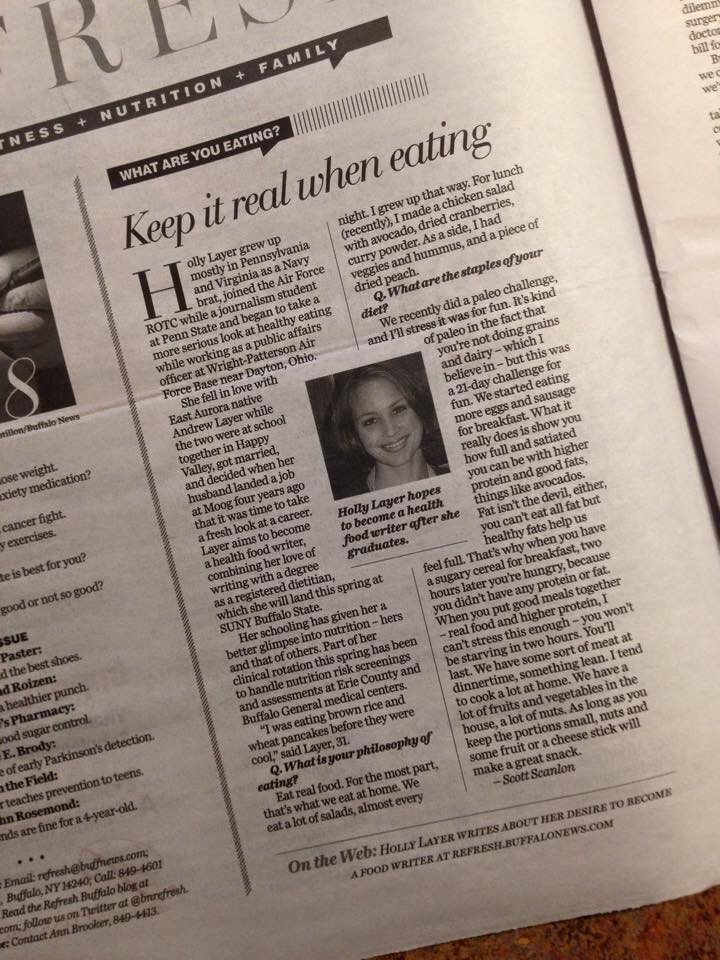
I was recently featured in the Buffalo News! Being a ‘reporter’ myself, it’s so fun to be on the other side of the interview every once in awhile.  I approached the BN Refresh (their Saturday Health and Wellness insert) editor, Scott Scanlon, awhile ago about contributing some guest blogs, and he offered to feature me in his ‘What Are You Eating?’ section. So far, I’ve contributed the National Nutrition Month blog and an ‘intro’ post on myself, which went live on the BN site yesterday.  I’ve also written a post on our recent Paleo experience, which I’ll send to Scott soon.  I’ll probably contribute a blog about once a month.

While I’m not getting paid for these pieces, I see this as a way to ‘break into’ the health/wellness/fitness/nutrition field.  Writing for the Advertiser is great, but I need to start preparing for what I want to do long-term: freelance writing about food and nutrition.  I’ve started researching writers’ guidelines for various publications and it’s overwhelming to say the least.  My dear friend, Emily (who I’m visiting this weekend), advised me to slow down and try to actually enjoy the process of ‘building my business’ (whatever that may be), instead of focusing on where I want to be and the fastest way to get there.  She’s a wise woman, that one.  It’s such a relief to know it’s OK to take it one day at a time, one pitch letter at a time, one article at a time.

For now, I’m still just plugging along at the projects I have to do this rotation–most of which ACTUALLY pertain to my future as a writer/nutrition counselor–and counting the days until graduation…55.