
I realize I’m a little late in the game (like, 18 days late) for this, but it’s National Nutrition Month!
The Academy of Nutrition and Dietetics (AND) celebrates NNM each March and uses it as a campaign to educate anyone who will listen about healthy eating. For those who don’t know, it is AND (through their accrediting arm) that ‘registers’ dietitians. I’m a member now as a student, and will be an RD in just a few short months!
I actually wrote a blog post for the Buffalo News Refresh section (spoiler alert–I was going to write a separate blog post about that–it will be forthcoming), which will go live tomorrow. Again, better late than never.
Below is what I wrote, but be sure to check out the Buffalo News Refresh blog (toward the bottom) to see my post. I’ll have more soon on my blogging opportunities as well.
Also, be sure to check out the New York State Academy of Nutrition and Dietetics’ first Public Service Announcement promoting Registered Dietitians here!
Bite into a Healthy Lifestyle
Every March since 1973, the Academy of Nutrition and Dietetics has dedicated time to increase awareness about making healthy choices and increasing physical activity. It began as a week-long campaign and lengthened to a month in 1980. Registered Dietitian Nutritionist Day, also in March, recognizes RDNs as nutrition experts who are uniquely qualified to provide nutrition services to the public.
This year, National Nutrition Month’s theme is ‘Bite into a Healthy Lifestyle,’ which encourages everyone to adopt eating and physical activity plans that are focused on consuming fewer calories, making informed food choices and getting daily exercise in order to achieve and maintain a healthy weight, reduce the risk of chronic disease and promote overall health.’ Read on for easy, simple ways to incorporate healthier choices into your lifestyle!
Consume Fewer Calories
Weight gain, while influenced by multiple factors, does come down to simple math: if you take in more calories than you burn, you’ll gain weight. Prevent that by finding ways to decrease your calorie intake.
-Consider counting your calories. If you don’t know how much you’re eating, it’s easy to go overboard. Click here to access MyPlate’s Super Tracker.
-Decrease your portion sizes.
-Drink a glass of water before meals and snacks. Often, we think we’re hungry when we’re simply thirsty.
-Start meals with broth-based soups, salads or veggies so you’ll have less room for the higher-calorie options.
-Eat fruit for dessert and keep cut-up veggies in the fridge for snacking.
-Don’t drink your calories. Switch from whole to 1% or skim milk, cut out sodas and other sugar-sweetened beverages. Opt for fruit instead of juice when possible.
Make Informed Food Choices
Knowledge is power. Take charge of your health by being proactive about what you eat.
-Read food labels. Note serving size, calories and fat in each, and limit yourself to that serving size.
-Go the extra mile and learn what carbohydrates, fats and proteins are. Go to ChooseMyPlate for more information about each nutrient and the amounts recommended for you.
-Prepare your meals and snacks in advance so that you’re never caught without a healthy option on-hand to grab when you’re in a rush.
-Look at online menus before going out to eat to find healthier options at your favorite restaurants.
Get Daily Exercise
It’s recommended that adults get at least 30 minutes of exercise most days of the week, and 60-90 minutes to prevent weight gain.
-Get a pedometer to track your steps; aim for 10,000 each day. For fun, team up with friends and compete to get the most steps.
-Have a dog? Get out and walk. Other good excuses to get outside include yard work and playing with your kids.
-Take the stairs instead of the elevator.
-Park your car at the far end of the parking lot to increase your steps each day.
-Find an activity you enjoy and do it. Not everyone enjoys running; your strength may be a Zumba class or spinning.
-Meet friends for a walk instead of coffee.
-Winter isn’t an excuse to stay inside—find an activity you enjoy. Snow shoeing, skiing, ice skating and even sledding burn calories, increase your heart rate and are fun ways to take advantage of the season.
For more information about National Nutrition Month, click here. Interactive quizzes and games are available online here.
 A typical day started with Jennifer giving me 4-5 patients who needed new assessments or follow-up assessments. Because there aren’t extra computers in the nutrition office, I usually wandered up to one of the floors and grabbed a computer at the nurses’ station, where I looked up each patient in the Electronic Medical Record and began charting.
 After beginning their assessments, which included information such as their diagnosis, past medical history, lab values, medications and current diet order, I would track each patient down in their rooms and ask them a few questions. Most of the time, I discussed their allergies, GI function, last bowel movement, nausea, vomiting, diarrhea, constipation and intake prior to admission.
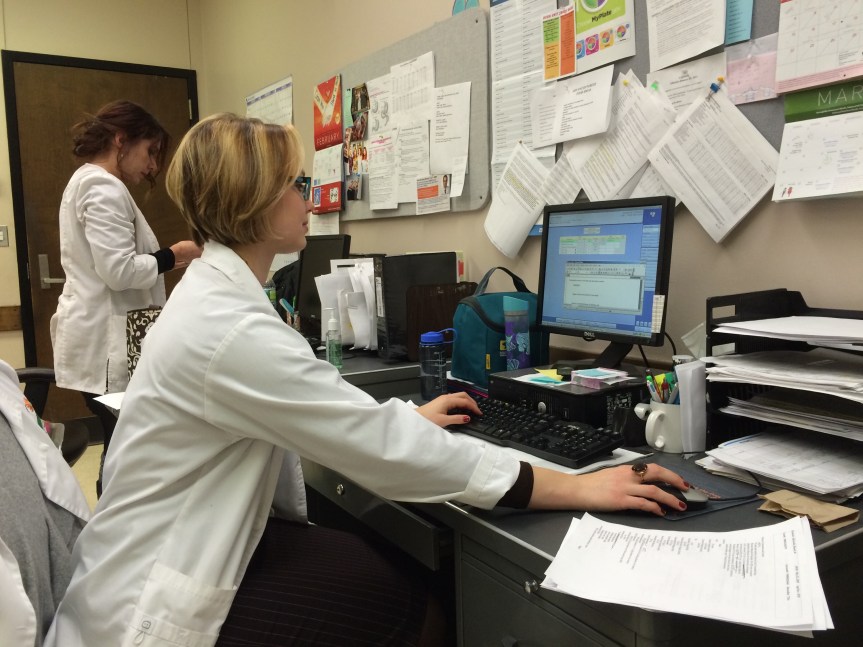 After I saw each patient, I’d go back to a computer and finish writing up the assessment and provide a recommendation, such as:
 While at ECMC, I accompanied Jennifer to her outpatient counseling sessions on Wednesdays. I really like outpatient counseling, which allows you to go much more in-depth with each person and individualize the session to their needs. I also made a ‘craft’ to display nutrition labels for teaching:
 Overall, I was very pleased with my rotation. I was able to get a lot of clinical experience with both general medical and surgical patients, as well as those in the ICU and on tube feeds. Additionally, I was able to get some outpatient counseling experience. I absolutely HATED getting up and out in time to drive into Buffalo in the mornings (in the worst weather EVER), which just solidified the fact that I do not want a full-time, in-Buffalo, hospital job. It’s just not for me. I hated being away from the house ALL day long. I did, however, surprise myself with how much I liked the clinical atmosphere and the ICU. I could see myself working 1-2 days a week in a clinical setting to keep my skills sharp, but not full time.


 thehealthypineapple